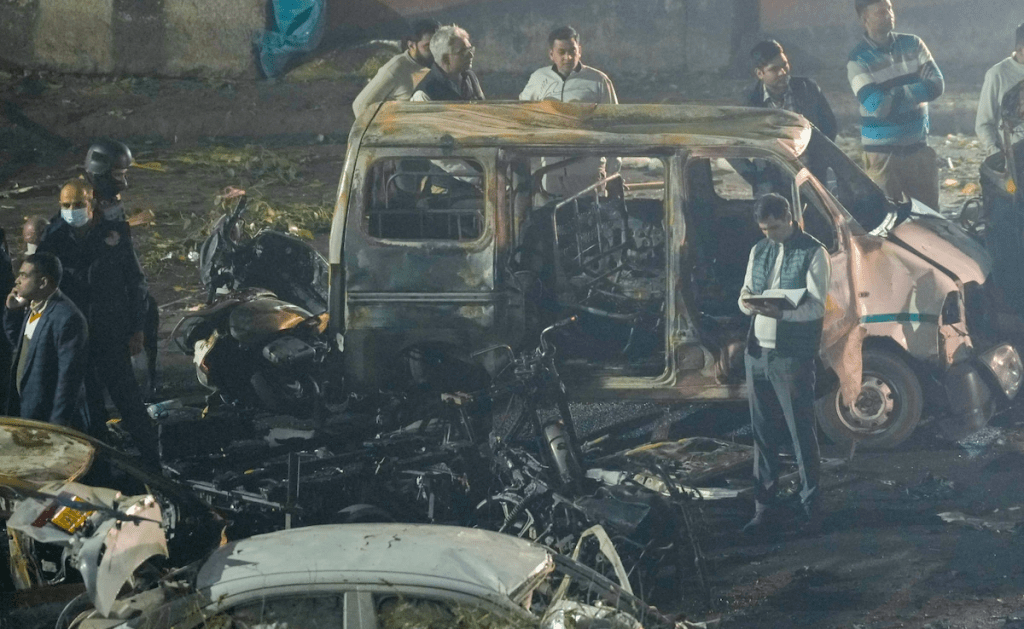
The timing, one must admit, was impeccable. Just days after Delhi police demonstrated their commitment to public safety by forcibly dispersing protesters demanding breathable air, apparently a radical notion in the world’s most polluted capital, an explosion near the Red Fort provided authorities with a far more palatable crisis to manage. Nothing deflects attention from systematic environmental failure and heavy-handed suppression of dissent quite like the spectre of terrorism.
When Pollution Protests Meet Police Batons
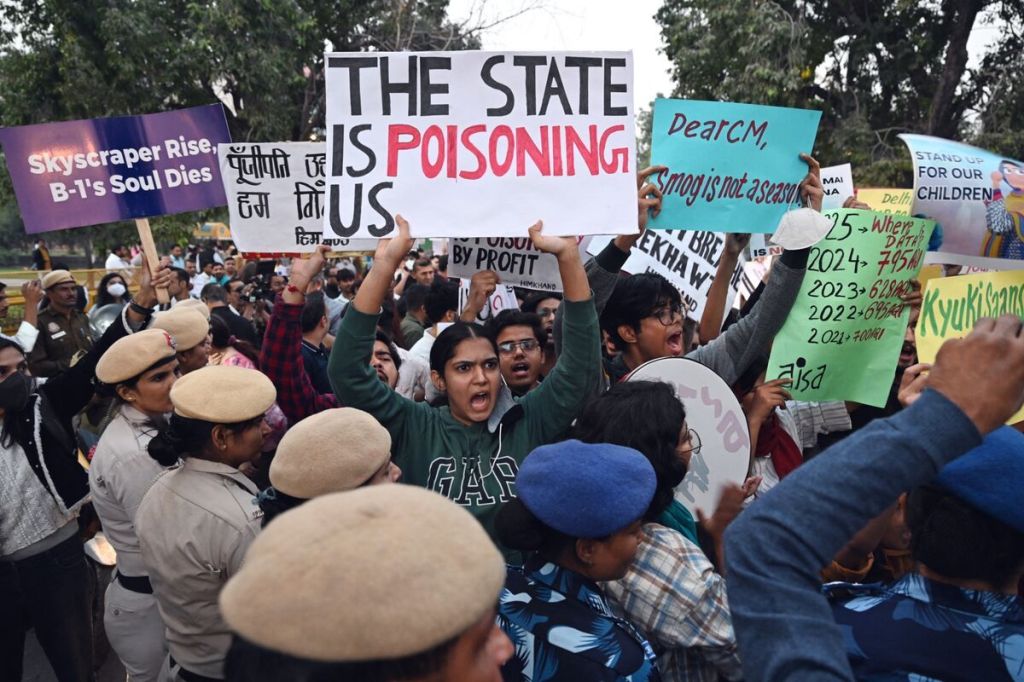
In the weeks preceding the November 10, 2025, blast, Delhi had been experiencing what health experts termed a “public health emergency,” though authorities seemed to prefer the designation “business as usual.” Air quality indices had reached levels that would qualify as hazardous waste in most contexts, with particulate matter concentrations prompting school closures and widespread health warnings.
What made these protests significant was not their size alone but their class composition. Students, informal sector workers, and sections of the petty bourgeoisie found themselves united around material conditions that transcended the communal divisions upon which Indian bourgeois politics usually depends. Health Policy Watch reported that Delhi police cracked down on the largest air pollution protest since the pandemic, with authorities detaining activists who had organized demonstrations against the hazardous air quality conditions.1 CBS News coverage documented how the pollution crisis had prompted active civil disobedience, with citizens increasingly unwilling to accept governmental inaction on environmental degradation.2
Such organizing poses immediate problems for capital. Environmental regulation adequate to make Delhi’s air breathable would require fundamental restrictions on industrial production, construction capital, and automobile-dependent urban development: the very sectors driving accumulation in the National Capital Region. The Indian bourgeoisie, operating within the constraints of dependent development and global commodity chains, cannot resolve this contradiction without threatening its own reproduction. The protests represented organizing on genuinely material terrain rather than the managed communal conflicts that characterize electoral politics.
The state’s response was characteristic: substantial force to disperse peaceful demonstrators, detention of organizers, and establishment that the right to assembly does not extend to those challenging the material conditions capitalism produces. Then came the blast, and the framework shifted entirely.
The Incident: Speed Over Substance
The explosion occurred near the Red Fort on November 10, resulting in casualties and immediate alarm. What distinguished the response was its predetermined character. Within hours, government officials had categorized the incident as terrorism. Not as an investigative finding, but as a political designation that would structure all subsequent state action.
The Guardian reported authorities treating the blast as a terror incident almost immediately,3 while Reuters coverage noted the explosion but provided limited technical details.4 Multiple reports indicated the absence of a crater at the blast site a detail that typically accompanies high-explosive detonations and serves as crucial forensic evidence. These technical anomalies received minimal attention in the rush toward classification.
The missing crater and limited explosive characteristics discussion reveal that evidentiary standards become irrelevant when state objectives are clear. The bourgeois state apparatus does not require proof in the forensic sense; it requires incidents that justify the deployment of repressive capacity against populations designated as threatening. Whether the blast resulted from terrorism, criminal activity, or other causes matters less than its political utility in authorizing comprehensive state action against Muslim and Kashmiri populations.
Demolition as Collective Punishment
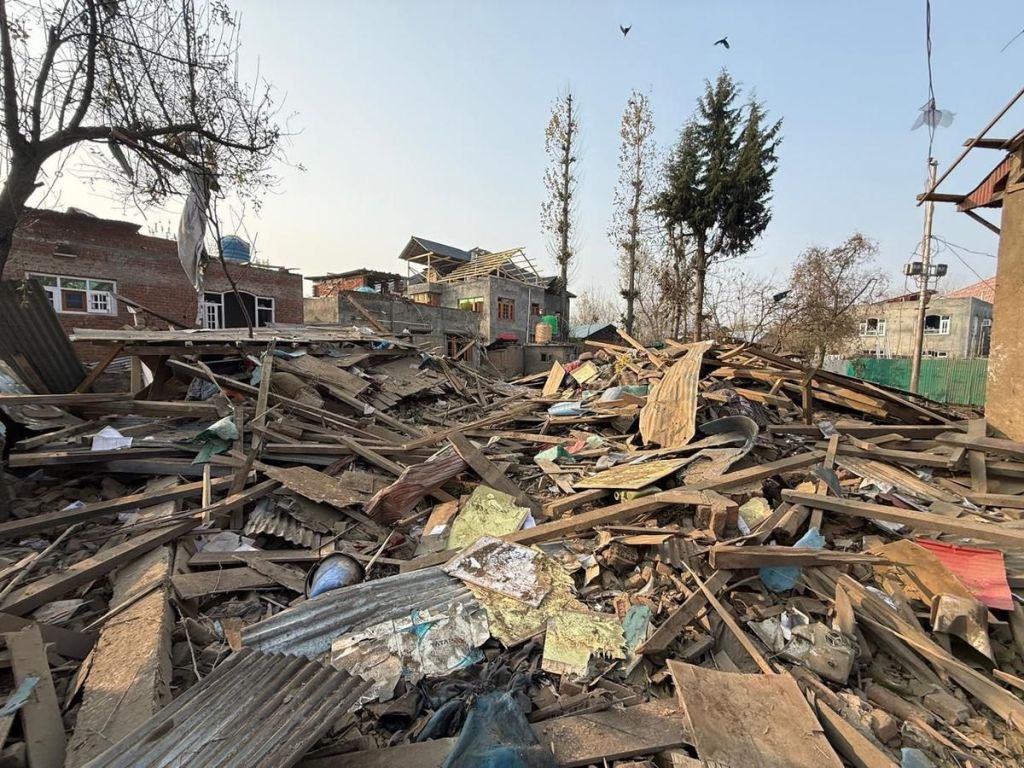
The National Investigation Agency’s subsequent operations demonstrated geographic breadth untethered to evidentiary focus. In Pulwama, security forces demolished the family home of an accused individual, an action The Wire documented as occurring despite ongoing legal controversies surrounding extrajudicial demolitions5. NDTV coverage noted the demolished residence belonged to a doctor linked to the investigation6, the destruction occurring before any trial, verdict, or establishment of guilt.
This practice extends beyond individual cases to function as systematic terror against entire communities. Property demolition serves disciplinary purposes: demonstrating to Muslim and Kashmiri populations the consequences of political deviance, actual or attributed. The destruction of family property for one member’s alleged actions establishes collective liability that operates outside any legal framework. This is not aberration or excess but the normal functioning of the state apparatus when managing populations designated as internal enemies.
The demolished homes serve pedagogical functions. They teach that constitutional protections, property rights, due process, individual rather than collective responsibility remain operational only insofar as populations remain politically compliant. Kashmir’s administrative status has long demonstrated that Indian constitutional provisions apply conditionally, their extension or withdrawal determined by political requirements rather than legal principles. The Article 370 revocation in 2019 made this explicit, but demolition practices show it operates everywhere the state confronts populations it designates as threatening..
Institutional Sanctions: Disciplining Social Mobility
The investigation’s focus on Al-Falah University and Al-Falah Medical College in Faridabad demonstrated that institutional affiliation functions as sufficient grounds for comprehensive sanction. The Hindustan Times reported NIA and Jammu and Kashmir police raids at these institutions, with multiple doctors coming under scrutiny.7
The National Herald India documented that the Association of Indian Universities suspended Al-Falah University’s membership following probe-related allegations8, before any convictions, based on the mere fact that associated individuals had been detained or questioned. Students, faculty, and staff with no connection to alleged activities found their academic credentials suddenly worthless, their professional futures foreclosed.
These institutions serve particular class fractions such as upwardly mobile Muslims seeking professional credentials and middle-class status. Their destruction is not incidental but targets the social mobility that might create economic independence and alternative power centers outside Hindu nationalist political control. Muslim professionals with economic autonomy pose management problems for communal politics that depends on maintaining Muslims as marginalized, economically precarious populations whose integration remains perpetually conditional.
The Times of India reported that agencies had uncovered what they characterized as a substantial plot involving explosives and multiple vehicles9, presenting investigative claims as established facts despite ongoing proceedings. The Deccan Chronicle documented major raids across Kashmir Valley involving sixteen simultaneous locations10, while the Hindustan Times subsequently reported additional detentions of individuals linked to Al-Falah University, including doctors and staff members.11 The breadth of action affecting hundreds of individuals, families, and careers proceeded on the basis of alleged associations rather than established participation..
Geographic Profiling
Perhaps the most revealing post-blast measure emerged in Gurugram, where police issued directives requesting housing societies provide comprehensive lists of residents from Jammu and Kashmir and foreign nationals. Scroll.in documented this measure12, which implemented surveillance based on place of origin rather than individualized suspicion or evidence.
This geographic profiling makes explicit what has long operated implicitly: Kashmir functions as internal colony, its populations subject to special administrative regimes, military occupation, and systematic surveillance that would be politically impossible in other Indian states. Kashmiris residing elsewhere in India find their constitutional status contingent, their freedom of movement and settlement subject to security apparatus oversight.
The measure serves multiple functions. It generates comprehensive databases of Kashmiri populations for ongoing surveillance. It creates hostile residential environments where housing societies, employers, and institutions view Kashmiri identity as security risk requiring special scrutiny. It establishes tiered citizenship where individuals face systematically different treatment based on regional origin. Most importantly, it maintains Kashmir’s colonial status by extending surveillance regimes beyond geographic borders to operate wherever Kashmiri populations reside.
Geographic profiling also serves economic functions. Systematic discrimination in housing and employment markets keeps Kashmiri populations economically marginal and politically manageable. Professional advancement becomes contingent on demonstrating exceptional political compliance. Economic integration that might create propertied Kashmiri populations with material interests in stability gets actively prevented through systematic exclusion.
The Pattern: State Apparatus in Normal Operation
Examining the totality of post-blast actions reveals response patterns extending far beyond targeted investigation. Property demolitions affecting families, institutional sanctions destroying careers, geographic profiling establishing systematic surveillance, and broad raids affecting entire communities collectively represent comprehensive deployment of state power.
This pattern reflects not aberration or authoritarian excess but the normal operation of the bourgeois state apparatus when managing populations designated as threatening to established order. The speed of implementation, often preceding any conclusive findings, demonstrates that state action follows political requirements rather than evidentiary standards. The absent crater and limited technical discussion about blast characteristics remain overshadowed by extensive operations because forensic accuracy is irrelevant to political objectives.
The response serves demonstration purposes. It shows Muslim and Kashmiri populations the comprehensive consequences familial, institutional, professional, residential of political deviance. It performs state capacity for Hindu majoritarian audiences, demonstrating decisive action against populations constructed as civilizational threats. It creates surveillance infrastructure and legal precedents for future deployment. Most critically, it transforms environmental protests and class-based organizing into security threats requiring counterterrorism response.
Conclusion: Convenient Crises and Inconvenient Questions
The incident must be analyzed not in isolation but as a node within intersecting crises of legitimacy, environmental collapse, and intensifying class antagonisms that characterize contemporary Indian capitalism. The environmental protests that preceded the blast represented a form of class-based organizing that transcended communal divisions, with students from diverse backgrounds united around material conditions affecting their collective wellbeing. Such organizing poses existential challenges to ruling class hegemony because it threatens to build working-class consciousness around shared material interests rather than divisive identity politics.
The Indian bourgeoisie cannot resolve these contradictions without fundamentally transforming property relations and challenging its subordinate position in global capitalism, transformations that would threaten its own class power. Instead, it manages contradictions through combination of communal mobilization and state repression. The Muslim and Kashmiri populations serve as convenient scapegoats for failures inherent to the system. Security threats, whether real or manufactured, justify expanding police powers and normalizing extra-constitutional measures. The constant invocation of terrorism and national security creates permanent state of exception where normal rights protections can be suspended indefinitely.
The Delhi blast investigation exemplifies this governance model. Whether the incident was genuine terrorist attack or something more ambiguous, it becomes almost irrelevant to its political function. The blast provided an opportunity to demonstrate state power, to reinforce communal narratives, to justify surveillance expansion, and to suppress dissent under national security pretexts. The bourgeois state increasingly relies on repression and communal mobilization because it has no other tools available within existing class relations.
The alternative requires working-class organization that transcends communal divisions and builds power on a genuinely proletarian terrain. This means rejecting the false choice between Hindu nationalism and secular bourgeois liberalism, both of which preserve capitalist relations and serve ruling class interests. It means building organizations that unite workers across religious and regional lines around shared material interests: decent wages, safe working conditions, environmental protection, adequate housing, quality education and healthcare. It means developing revolutionary consciousness that understands these struggles as elements of larger conflict between classes, not isolated grievances to be resolved through reform.
The trajectory of contemporary Indian capitalism points toward either successful working-class revolution that establishes communism or capitalism’s descent into barbarism marked by environmental catastrophe, inter-imperialist war, and intensifying domestic repression. There is no middle path of reformed capitalism that resolves these contradictions because they are inherent to the system itself. The pattern evident in the Delhi blast response reflects not aberration but the logical operation of a system that must continually reproduce the conditions of its own crisis while preventing the emergence of forces capable of transcending it.
—
Footnotes:
1. Health Policy Watch, “Delhi police crackdown on largest air pollution protest since pandemic,” November 2025.
2. CBS News, “Air pollution in Delhi, India closes schools, draws protests and health warnings,” November 2025.
3. The Guardian, “India confirms deadly Delhi car blast being treated as terror incident,” November 12, 2025.
4. Reuters, “Explosion reported near Red Fort in Indian capital New Delhi,” November 10, 2025.
5. The Wire, “Family Home of Delhi Blast Accused Doctor Demolished in J&K’s Pulwama.”
6. NDTV, “Delhi Bomber Umar Mohammad’s House In J&K Demolished By Security Forces.”
7. Hindustan Times, “NIA, J&K police raid Al-Falah college, four doctors under lens.”
8. National Herald India, “Association of Indian Universities suspends Al-Falah University’s membership following terror probe links.”
9. Times of India, “Explosions with 32 vehicles in Delhi car blast probe: Agencies uncover Dr Umar’s terrifying plot.”
10. Deccan Chronicle, “Major raids across Kashmir Valley in Delhi blast probe.”
11. Hindustan Times, “Red Fort blast probe: Five more detained including two doctors linked to Al-Falah University.”
12. Scroll.in, “After Delhi blast, Gurugram police asks housing societies to list residents from J&K, foreigners.”

 No War But the Class War Initiative in South Asia
Leave a reply to fsdfsdf Cancel reply