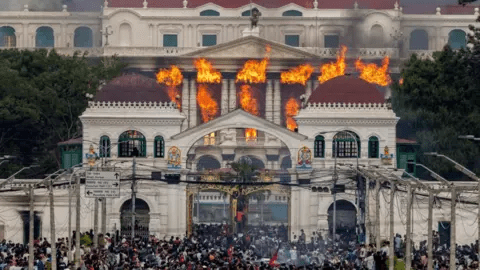
The global capitalist system is in crisis, and the protests in Nepal reflect this reality. Across the world we see wars, repression, strikes, and uprisings. In every case, the ruling class tries to stabilize its rule by attacking workers and ordinary civilians. The current events in Nepal are a perfect example.
The Nepal Protests
In Nepal, students and young people have risen up violently and even overthrown the existing capitalist government.
The Gen Z protests began after the government imposed a ban on social media platforms. Nepal is a country of 30 million people that relies heavily on remittances from nearly 2 million workers abroad. In 2024, the $11 billion they sent home accounted for more than 26 percent of Nepal’s economy. This money provides food, medicine, and education for their families. The ban on social media—imposed because platforms like Facebook and YouTube did not register with the government—cut off families from their faraway breadwinners.
This shows the dark economic reality of Nepal: a deep job crisis that forces workers to migrate for employment. According to the Nepal Living Standards Survey published in 2024, unemployment stood at 12.6 percent, higher than five years earlier. This only covers the formal sector, while the majority of Nepalis work in the informal economy. On top of this, corruption runs deep, with officials tied to foreign loans from imperialist countries, including China, which are repaid by extracting surplus from the Nepali masses.
This created the conditions for collapse. When the government responded by killing young protesters with bullets, the students and youth struck back, attacking state institutions such as Parliament, the Supreme Court, and others. This demonstrates the enormous rage that exists among the people against the status quo.
Similar Context
A similar incident happened in Bangladesh a few months ago, when students overthrew Sheikh Hasina’s government through violent protests. But this did not change anything fundamentally, except for a few minor reforms. Arguably however, the situation has gotten worse than before with widespread economic ruin, out of control inflation and the meteoric rise of Islamists in going from fringe parties whose only bet at power was being in coalition with larger parties to a situation where they are front runners for the next election. As a result, violence against religious minorities have gotten more widespread. There are stronger voices to curtail the freedom of women than ever before. Student Union elections are a large and dramatic affair in Bangladesh and even the stronghold of leftism in Bangladesh, Dhaka University has now elected Islamists as the dominant force.
There also seems to be this ongoing “South/South East Asian” Spring with Myanmar in 2021, Sri Lanka in 2022, Bangladesh and Indonesia very recently. Without strong revolutionary organisations, nothing positive will come out of this unrest.
Communist Conclusions
From these events, communists can draw several conclusions:
- Students and youth are not a revolutionary force. They may be radical, but they cannot bring about fundamental change. It is a bourgeois illusion that they are revolutionary. The only revolutionary force across the world is the proletariat—the working masses who build society and embody the negation of private property. Without their leadership, no movement can fight the root cause of oppression.
- Social democracy and its variants must be rejected. Nationalism, liberal democracy, Marxism-Leninism, and Maoism all belong to the dustbin of history and must be smashed violently.
- Workers must wage an independent struggle. This struggle must go beyond national boundaries and be guided by a scientific programme born from historical class struggle.
- The capitalist state must be destroyed. No real change is possible without crushing the state machinery of capital.
Tactical Suggestions for the Nepali Proletariat
- Leave all “Marxist-Leninist”, Maoist, and liberal parties. Begin political struggle against them. Organize in the form of workers’ committees and armed workers’ councils under a centralized programme. If possible, build an internationalist party or organization. An internationalist party would be indispensable for the struggle.
- Carry out political and violent struggle against imperialist NGOs, reactionary monarchist and nationalist forces, and the state machinery. Struggle also against reformist tendencies such as liberals and Maoists.
- Capture factories, food resources, energy resources, transport, and arms.
- Organize workers’ meetings. Build contact with workers’ organizations across nearby borders in Bangladesh, India, China, etc.
- Raise political demands for resources to be handed to workers’ committees. Advance slogans for permanent employment, reduced working hours, and nationalization of resources.
- Raise slogans for abolition of bureaucratic privilege. Struggle against landlords in alliance with peasants.
- Since students are heavily involved in these protests—especially against elite privilege—raise the political demand for universal free education for all.
Conclusion
The Nepal protests show the anger of the masses, but also the limits of spontaneous youth rebellion. Only the working class, organized independently and guided by a revolutionary programme, can turn such uprisings into a decisive struggle against capitalism.


Leave a Reply