“Let us declare that the state of war does exist and shall exist so long as the Indian toiling masses and the natural resources are being exploited by a handful of parasites. They may be purely British capitalist or mixed British and Indian or even purely Indian. They may be carrying on their insidious exploitation through mixed or even purely Indian bureaucratic apparatus. All these things make no difference.”
-Bhagat Singh
Bhagat Singh’s words, written under colonial rule, speak with startling relevance to the present. The exploitation he condemned has not vanished. It has adapted. In Ladakh today, the mechanisms of extraction wear new institutional forms, but their function remains unchanged: to subordinate land, water, and labor to the logic of capital.
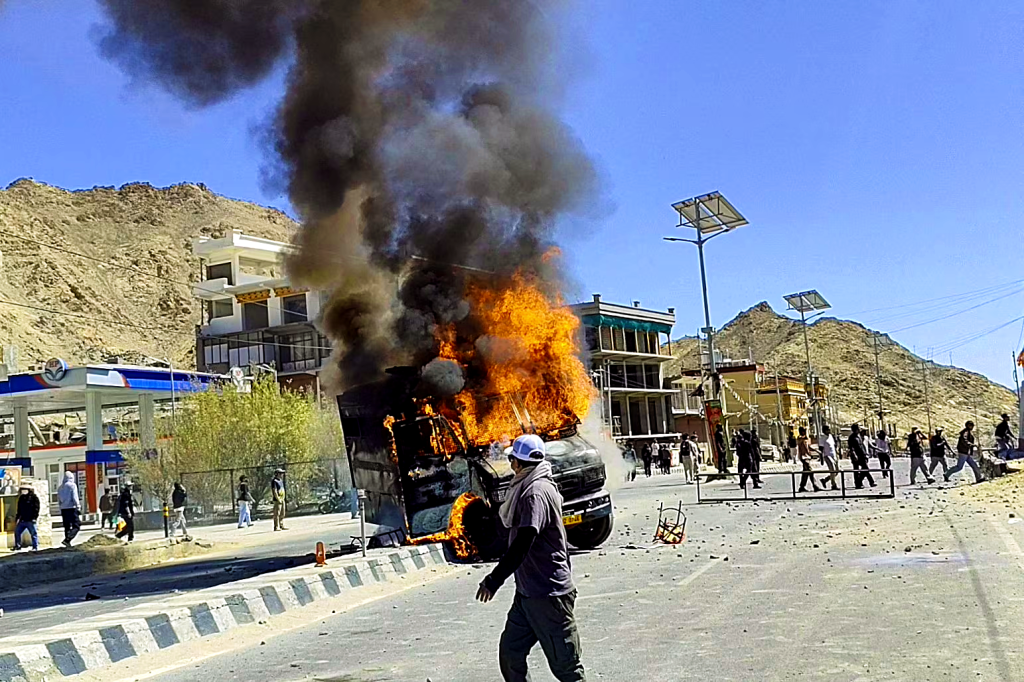
The September 2025 protests in Leh – marked by the burning of a security vehicle outside the BJP office and the swift imposition of curfew – are not sudden outbursts. They emerge from years of systemic dispossession, deepening precarity, and the steady erosion of local autonomy. What unfolds in Ladakh exceeds the bounds of a constitutional dispute or a narrow demand for regional self-rule. It reflects a broader pattern through which territories endowed with strategic location and abundant natural resources are restructured to serve the imperatives of national and global capital.
In the icy heights of the Himalayas, far from the boardrooms of Delhi and the stock exchanges of Mumbai, a fire has been lit. This fire is the September 2025 uprising in Ladakh, which culminated in violent clashes, the torching of a security vehicle outside the BJP office in Leh, and the immediate declaration of curfew. These acts express a profound rupture between the local population and a state apparatus that treats their land, water, and livelihoods as expendable inputs for capital accumulation. The unrest erupted on the fifteenth day of a thirty-five-day hunger strike organized by the Leh Apex Body, the Kargil Democratic Alliance, and allied groups demanding statehood, inclusion under the Sixth Schedule, job security, and protection of land rights. When two fasting protesters collapsed and were hospitalized, enraged youth surged into the streets and set fire to the BJP office. Police responded with live ammunition, killing six and injuring dozens. In the aftermath, Sonam Wangchuk called off the protest and publicly denounced the violence – a stance reminiscent of his 2024 decision to end a similar fast after student and environmental mobilizations, which he then dismissed as driven by “ulterior motives.” Meanwhile, national media outlets and BJP-aligned commentators have launched a coordinated propaganda campaign branding the demonstrations as “Congress-instigated,” attempting to delegitimize the genuine and long-standing grievances of Ladakh’s people.
Official narratives, echoed even by sections of the liberal press, frame the unrest as a constitutional dispute. Beneath this juridical surface lies a material reality shaped by imperialist competition and capitalist crisis. The geopolitical situation in the region warrants a scale-up of security infrastructure along the border. Ladakh is rich in natural resources. Uranium mineralization has been identified in the Nubra Valley, though the scale of economically viable deposits remains uncertain. Rare earth elements vital raw materials for modern technologies are also reported across parts of the region. India currently imports about 95 percent of its rare earth requirements. With abundant land and water resources, the central government envisions Ladakh as a hub for electronics manufacturing and data centers.
Ladakh is also positioned as a renewable energy powerhouse. In 2021, New Delhi finalized plans to build seven hydroelectric projects with a combined capacity of 2,070.02 MW, adding to the existing 90 MW of hydroelectric generation. A 13 GW solar power plant has been approved for Pang. Geothermal energy development is underway at Puga, targeting 100 MW of capacity. The vast majority of this energy will be transmitted to other parts of the country. Ladakh’s internal power demand stands at only 50 MW, less than 0.3 percent of the total projected capacity from existing and proposed projects.
Clearly, Ladakh is an area of strategic interest and heavy investment for the central government. Yet local populations report seeing none of the promised benefits.
After the constitutional changes of August 5, 2019, Ladakhi youth lost eligibility for key public sector positions. They can no longer apply for gazetted officer roles (a category of senior civil servants in India whose appointments are officially published in the government gazette, granting them significant administrative authority and job security) through the former Jammu and Kashmir Public Service Commission or for jobs at the J&K Bank. No gazetted officer recruitment has taken place in Ladakh since 2019. In 2022, a special drive for 797 non-gazetted posts under the Union Government’s State Service Commission drew 30,000 applicants from the region. In 2023, the Ladakh Autonomous Hill Development Councils (LAHDC) recruited seven graduates and one science postgraduate for the role of “sweeper cum scavenger.” This illustrates the extreme precarity facing Ladakh’s educated youth. Unemployment in the region rose by 16 percent between 2021-22 and 2022-23. Graduate unemployment stands at 26.5 percent, among the highest in India.
The removal of constitutional land protections has accelerated dispossession. Large tracts are now being allocated for national projects. Eighty square kilometers of land were requisitioned for the solar project at Pang. Local communities have raised serious concerns about this. Ladakh already faces water shortages, relying heavily on glacial melt. Global warming is accelerating the retreat of Himalayan glaciers, including those in Ladakh. Mega-infrastructure projects threaten the region’s fragile ecosystem. The government’s draft Ladakh Industrial Land Policy 2023 sparked widespread alarm over its environmental and social consequences.
Local self-governance has been systematically dismantled. After August 5, 2019, the LAHDCs of Leh and Kargil lost their financial, revenue, and constitutional powers. They now operate as subordinate executive bodies under central bureaucracy. Despite a fivefold increase in Ladakh’s annual budget since 2019 – now exceeding ₹50 billion – the two councils receive only ₹7 billion, or 14 percent of the total. Political representation has also been slashed. Ladakh now has a single Member of Parliament. Previously, it sent four Members of the Legislative Assembly to the (now dissolved) Jammu and Kashmir legislature.
The demand for inclusion under the Sixth Schedule (a provision in the Indian Constitution that grants autonomous administrative powers to certain tribal areas in the Northeast, allowing them to form Autonomous District Councils with legislative, judicial, and financial authority over local matters such as land, forests, and customary law) is often presented as a solution. In reality, it functions as a trap within the bourgeois legal order. Across India, tribal communities are routinely denied the nominal protections of the Sixth Schedule. In central India, Gond and other Adivasi (a collective term for the indigenous peoples of India, often marginalized and dispossessed of ancestral lands) peoples inhabit mineral-rich territories but remain confined under the Fifth Schedule. This legal framework facilitates, rather than prevents, land alienation and corporate plunder.
In Bastar, counterinsurgency operations branded as anti-“Naxal” campaigns target ordinary Adivasis. Paramilitaries, state-backed vigilantes, and police displace villages, clear forests for mining, and subject women to militarized sexual violence. Democratic institutions offer no redress. Communities encounter barracks and checkpoints instead of schools and clinics. Hunger, malnutrition, and cultural disintegration follow.
This is not accidental. Excluding Ladakh from the Sixth Schedule while keeping Adivasi lands under the Fifth is a deliberate imperialist strategy. It creates legal pathways for capital to extract resources. At the same time, it brands resistance as “anti-national” or “insurgent.” Whether in Bastar or Leh, the state deploys the same triad: legal exclusion, militarized control, and corporate plunder. All of this is wrapped in the rhetoric of “development” and “security.”
These are not ethnic or regional issues. They are expressions of capitalism’s terminal crisis. Every square metre of land, every drop of water, and every human community becomes a site of intensified exploitation. The so-called “green transition” is not ecological salvation. It is a new phase of imperialist accumulation, driven by the falling rate of profit and the scramble for strategic raw materials.
The protesters in Leh were overwhelmingly young – students, unemployed graduates, small traders. They are not separatists. They are part of the reserve army of labour in a region with no industry, no public sector expansion, and no future under the current order. Their anger is existential. When they set fire to a police van, they targeted the apparatus that enforces land grabs, corporate leases, and ecological ruin.
This revolt, like struggles in Bastar or Jharkhand, lacks autonomous class consciousness. It is framed in terms of rights, justice, or autonomy, not as a rupture with the capitalist mode of production. The working class in Ladakh – scattered across tourism, transport, and petty commerce – has not formed independent organs of struggle. Strike committees, neighborhood assemblies, and workers’ councils remain absent. Instead, protest energy flows into civil society bodies like the Leh Apex Body (LAB). Despite grassroots origins, LAB remains committed to negotiating with the very state that is dispossessing its people.
Such bodies are not neutral. They function as intermediaries of bourgeois order. They channel proletarian anger into constitutional dead-ends. They reinforce the illusion that the state can be reformed. This is the logic of the left of capital – whether in the form of NGOs, “progressive” lawyers, or regional elites. Their aim is to manage exploitation, not abolish it.
Ladakh’s strategic location places it at the heart of the US-China imperialist rivalry. As the capitalism’s crisis has no reformist solution. War and intensified exploitation are the only options left to the ruling class. The Indian state, integrated into the US-led imperialist bloc, treats Ladakh as a military and extractive outpost. Infrastructure projects – roads, airstrips, surveillance networks – serve the logistics of war and control, not local development.
The so-called border dispute masks a deeper struggle. Control over uranium, rare earths, water, and energy corridors is at stake. These are the raw materials of the next phase of imperialist accumulation and war production. The same dynamic unfolds in Ukraine, Gaza, the Congo, and the Sahel. Local populations are sacrificed on the altar of inter-imperialist competition. There is no peace in this system. Only temporary truces that prepare the ground for wider slaughter.
The indigenous struggle in Ladakh must not be abandoned. It must be generalized beyond identity and territory. The fight to protect Ladakhi land is inseparable from the fight of Adivasis in Bastar, Dalit agricultural laborers in Punjab, and garment workers in Tamil Nadu. All confront the same enemy: a capitalist state integrated into the global imperialist order. This state treats human beings and ecosystems as raw material for accumulation.
What is needed is not a Ladakhi solution, but a proletarian one. It must be rooted in workplace and community assemblies that bypass NGOs, political parties, and all forms of representation. Solidarity strikes with workers across India and the world are essential. These workers face the same austerity, precarity, and repression. Refusal of militarization, whether by Indian or Chinese capital: is central. Opposition to all imperialist blocs is non-negotiable. Internationalist links with anti-extractivist movements – from the Andes to the Congo is an absolute necessity. These cannot achieve anything as just an alliance of “the people”. These protests are the expression of a single, global class struggle but the importance of internationalist organisation is paramount, if we ever hope to utilise these expressions of proletarian anger into a single movement capable of real change.
Only when the youth of Leh see themselves as proletarians resisting capitalist enclosure can their struggle escape the cycle of protest, repression, and co-optation.
The fire in Leh targeted more than a BJP office. It expressed rage against a system that turns glaciers into commodities and people into obstacles. Fire alone is not enough. Without autonomous organization, without revolutionary theory, and without an internationalist communist perspective, even the fiercest rebellion becomes a footnote in the annals of managed dissent.
The task of revolutionaries is not to lead from above. It is to clarify, connect, and catalyze. They must show that the only true “Sixth Schedule” is the one written by the working class in the language of expropriation, solidarity, and common ownership.
Liberation will not come through Parliament, the Supreme Court, or any bourgeois institution. It will emerge from the streets, the workplaces, and the collective self-activity of a class that has nothing to lose but its chains. This class has everything to gain from a world without borders, bosses, or power plants built on stolen land and frozen water.
 No War But the Class War Initiative in South Asia
Leave a comment